
Eigenes Lager oder Fulfillment Dienstleister: Wir digitalisieren deinen Versand und machen uns die Hände schmutzigWe digitalise your shipping ... and get our hands dirty doing it
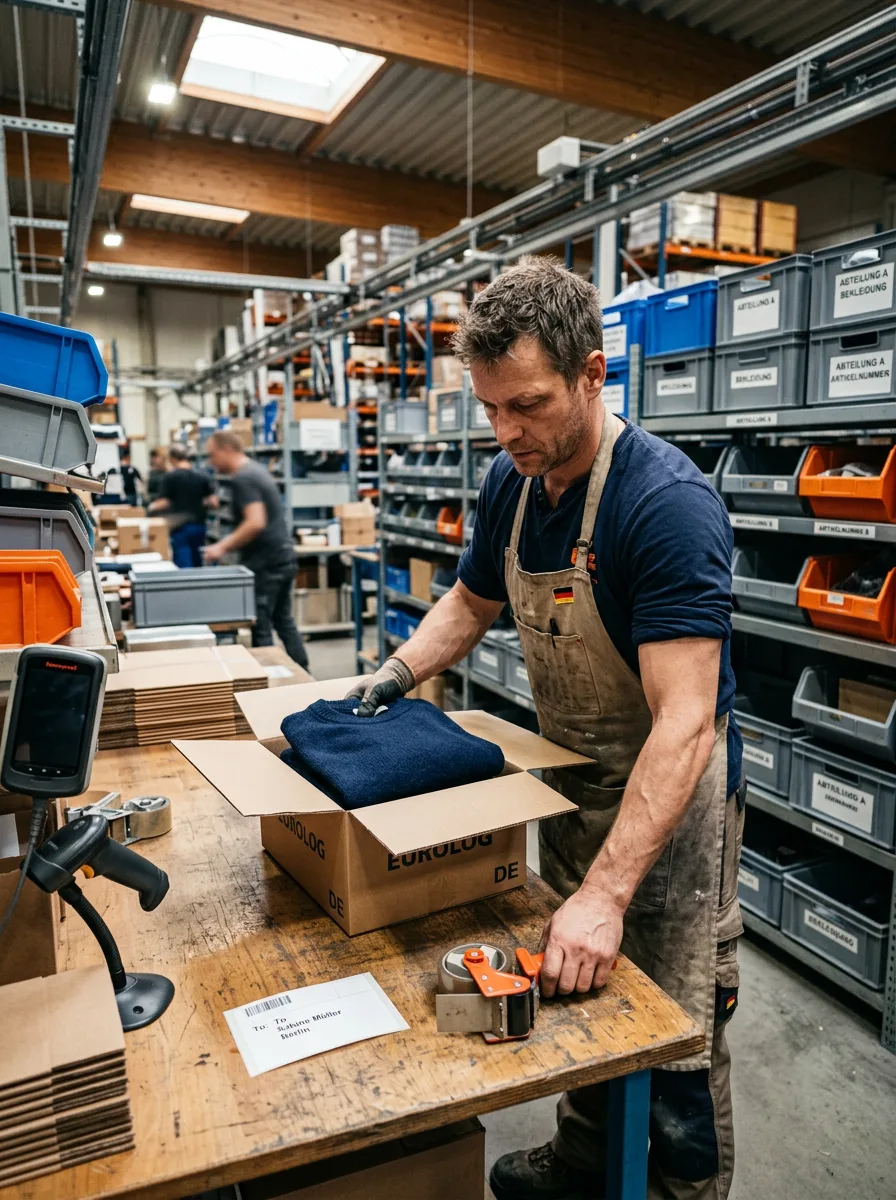
Eigenes Lager oder Fulfillment Dienstleister? Diese Frage stellt sich spätestens dann, wenn im Büro die Kartons stapeln und das Team lieber am Produkt arbeiten würde als am Paketband. Dieser Beitrag zeigt, was ein Dienstleister konkret übernimmt und wann der Wechsel sinnvoll ist.
Die digitale Welt hat ein analoges Problem!
Stell dir vor: Der Shop läuft rund, die Ads performen, die Conversion Rate macht Freude und das Dashboard leuchtet in beruhigendem Grün. Du lehnst dich kurz zurück. Schöne Sache, diese digitale Welt.
Dann kauft jemand etwas! 😱
Und plötzlich muss irgendwo ein realer Mensch aufstehen, in ein reales Regal greifen, ein reales Produkt in eine reale Schachtel legen und diese reale Schachtel an einen realen Zusteller übergeben. Kein Algorithmus der Welt erledigt das für dich. Kein Dashboard-Widget. Kein Plug-in.
Zwischen Klick und Klingel an der Haustür liegt die physische Welt mit allem, was dazugehört: Lagerplatz, Verpackungsmaterial, Versandlabel, vorbereiteter Retourenprozess und gelegentlich auch ein kaputter Karton. So charmant die Benutzeroberfläche deines Shops auch sein mag, sie hält das nicht auf.
Genau hier beginnt das Thema Fulfillment. Und genau hier beginnt die Frage, wer sich diese Arbeit eigentlich ans Bein bindet? Du selbst, oder jemand, der es täglich und gerne tut.
Was ein Fulfillmentdienstleister tatsächlich macht.
Stell dir vor: Eine Kundin bestellt abends um 22 Uhr über deinen Shop. Du sitzt gerade auf dem Sofa. Niemand tippt eine E-Mail, niemand greift zum Paketband und trotzdem verlässt die Bestellung morgen früh das Lager. Genau das ist der Punkt, an dem wir ins Spiel kommen.
Der Ablauf dahinter ist handfest, im wörtlichen Sinne. Zunächst trifft die Ware im Lager ein. Beim Wareneingang wird sie geprüft, gezählt und erfasst. Dann kommt die Einlagerung: jedes Produkt bekommt seinen festen Platz im System und im Regal.
Geht eine Bestellung ein, folgt die Kommissionierung. Dabei läuft tatsächlich jemand durch die Regalreihen, holt die richtigen Artikel und bringt sie zur Packstation! Ein echter Mensch. Evtl. unterstütz durch etwas Robotik.
Dann wird die Sendung verpackt, etikettiert und für den Versand vorbereitet. Und wenn ein Paket zurückkommt, übernimmt der Dienstleister auch die Retoure: prüfen, einbuchen, wieder einlagern oder aussortieren.
Das klingt unspektakulär. Es ist auch unspektakulär. Aber es muss jeden Tag zuverlässig funktionieren.
Für dich bleibt alles digital. Denn es gibt die Anbindung im Hintergrund.
Stell dir vor: Ein Kunde bestellt um 14:23 Uhr in deinem Shop. Um 14:24 Uhr liegt der Auftrag bereits im Lager vor. Du hast nichts getan. Du hast nicht einmal hingeguckt. Genau so soll es sein.
Moderne Fulfillmentdienstleister wie FulGrid° Fulfillment binden sich per Schnittstelle direkt an dein Shopsystem, deinen Marktplatz oder dein Warenwirtschaftssystem an. Ob Shopware, Shopify, WooCommerce oder ein Marktplatz wie Amazon und Otto, völlig egal. DIe Bestelldaten fließen automatisch ins Lager, ohne dass du manuell etwas exportierst, weiterleiten oder anstoßen musst.
Im Lager wird die Bestellung kommissioniert und verpackt, und sobald das Paket den Weg zu deinem Kunden antritt, läuft die Trackingnummer automatisch zurück in deinen Shop. Dein Kunde bekommt seine Versandbestätigung, du siehst den Status in deinem System und vom eigentlichen Greifen, Wiegen und Klebebandabreißen merkst du rein gar nichts.
Das ist keine Magie, sondern sauber konfigurierte Logistik. Der physische Prozess läuft vollständig im Hintergrund ab, während du dich um das kümmerst, wofür du eigentlich angetreten bist: deine Marke, dein Sortiment, deine Kunden.
Wann es Sinn macht, die Hände abzugeben.
Stell dir vor: Dein letzter Launch läuft besser als erwartet. Die Bestellungen kommen rein, dein Team ist ausgelastet, und irgendwo im Büro stapeln sich Kartons, die eigentlich längst raus sollten. Na Herzlichen Glückwunsch! Du hast ein Wachstumsproblem!
Genau in diesem Moment fragen sich viele Gründerinnen und Geschäftsführer, ob sie wirklich selbst Paketklebeband kaufen, Lagerplatz organisieren und Retouren sortieren wollen. Die ehrliche Antwort: meistens nicht.
Eine Auslagerung der Logistik macht immer dann Sinn, wenn das Bestellvolumen so weit wächst, dass interne Ressourcen dauerhaft unter Druck geraten. Wenn das Team seine Zeit lieber in Produkt, Marketing oder Kundenservice investieren soll. Und wenn Skalierbarkeit gefragt ist, ohne dass sofort ein eigenes Lager, eigene Technik und eigenes Personal dahinter stehen müssen.
Kurz gesagt: Sobald die Logistik anfängt, Energie zu fressen, die woanders gebraucht wird, ist es Zeit.
Du willst wissen, ob dein Bestellvolumen und deine Strukturen zu einem externen Fulfillment passen? Dann meld dich! Wir schauen es uns gemeinsam an.
Passend dazu: Kein Lager, keine Krankmeldung: Was Händler gewinnen, wenn die Logistik außer Haus geht
The digital world has an analogue problem!
Picture this: the shop is running smoothly, the ads are performing, the conversion rate is a joy to look at and the dashboard glows a reassuring green. You lean back for a moment. Lovely thing, this digital world.
Then someone buys something! 😱
And suddenly, somewhere, a real person has to get up, reach into a real shelf, put a real product into a real box and hand that real box over to a real delivery driver. No algorithm in the world will do that for you. No dashboard widget. No plug-in.
Between the click and the doorbell lies the physical world with everything that comes with it: storage space, packaging material, shipping labels, a prepared returns process and, every now and then, a crushed cardboard box. However charming your shop's user interface may be, it won't stop any of that.
This is exactly where the topic of fulfilment begins. And this is exactly where the question begins of who actually takes on this work? You yourself, or someone who does it every day and enjoys it.
What a fulfilment provider actually does.
Picture this: a customer orders through your shop at 10 pm. You are sitting on the sofa. Nobody types an email, nobody reaches for the packing tape, and yet the order leaves the warehouse tomorrow morning. That is exactly the point where we come in.
The process behind it is hands-on, quite literally. First, the goods arrive at the warehouse. During goods receipt they are checked, counted and recorded. Then comes storage: every product gets its fixed place in the system and on the shelf.
When an order comes in, picking follows. Someone actually walks along the shelf aisles, collects the right items and brings them to the packing station! A real human being. Possibly supported by a bit of robotics.
The shipment is then packed, labelled and prepared for dispatch. And if a parcel comes back, the provider also handles the return: inspecting, booking in, restocking or sorting out.
That sounds unspectacular. It is unspectacular. But it has to work reliably every single day.
For you, everything stays digital. Because the integration runs in the background.
Picture this: a customer orders in your shop at 2:23 pm. At 2:24 pm the order is already in the warehouse. You did nothing. You didn't even look. That is exactly how it should be.
Modern fulfilment providers like FulGrid° Fulfillment connect directly to your shop system, your marketplace or your ERP system via an interface. Whether Shopware, Shopify, WooCommerce or a marketplace like Amazon and Otto, it makes no difference. The order data flows automatically into the warehouse without you having to export, forward or trigger anything manually.
In the warehouse the order is picked and packed, and as soon as the parcel sets off towards your customer, the tracking number automatically flows back into your shop. Your customer receives their shipping confirmation, you see the status in your system, and of the actual grabbing, weighing and tearing off of tape you notice absolutely nothing.
That isn't magic, it's cleanly configured logistics. The physical process runs entirely in the background while you take care of what you actually set out to do: your brand, your range, your customers.
When it makes sense to hand things over.
Picture this: your latest launch is going better than expected. The orders are coming in, your team is at full stretch, and somewhere in the office boxes are piling up that should have gone out long ago. Well, congratulations! You have a growth problem!
This is exactly the moment when many founders and managing directors ask themselves whether they really want to buy packing tape, organise storage space and sort returns themselves. The honest answer: usually not.
Outsourcing logistics always makes sense when order volume grows to the point where internal resources are permanently under pressure. When the team should be investing its time in product, marketing or customer service instead. And when scalability is needed without immediately having to put a warehouse of your own, your own technology and your own staff behind it.
In short: as soon as logistics starts eating up energy that is needed elsewhere, it's time.
Want to know whether your order volume and your structures are a good fit for external fulfilment? Then get in touch! We'll take a look at it together.
Einfach konfigurierenEasy configure
Konfigurieren Sie Ihr Fulfillment-AngebotConfigure Your Fulfillment Offering
Jetzt Angebot anfordernRequest a Quote Now